Picture the last safety training your crew sat through. Maybe it was a conference room, a projector, and a slide deck that hasn't been updated since the flip phone era. Maybe it was an online module where the real skill being tested was how fast someone could click "Next."
Either way, everyone walked out with a certificate. The question is whether anyone walked out ready.
For most safety topics, that gap is frustrating. For confined space rescue, it's dangerous. When someone goes down in a permit-required confined space, nobody on the attendant side has time to pull up a PowerPoint. They have what's in their hands and what's in their memory. That's it.
That's why we built most of our confined space rescue training around doing, not watching.
Knowing Isn't the Same as Doing
Classroom and online training are good at one thing: transferring information. You can learn what a tripod is, what a winch does, and what an attendant's responsibilities are from a slide.
What you can't learn from a slide is how a harness actually feels when it's adjusted right. Or how much effort it takes to crank a winch with a person on the other end. Or what it's like to coordinate with two coworkers while someone is suspended below you.
Those are physical skills. Physical skills are built one way: by doing them, more than once, with someone who knows what they're doing watching you. Reading about a rescue is like reading about riding a bike. Useful context. Not the same thing.
Inside Our Mobile Confined Space Training Trailer
Our confined space training starts with a short classroom portion to cover the fundamentals. Most of the session, though, happens in a purpose-built training trailer that we bring to your site, so your crew gets on-site confined space training on real rescue equipment. Here's what a session looks like.
It starts with the harness. Before anyone goes near a space, every person puts on a harness, learns how to wear it properly, and learns how to inspect it. It sounds basic. It's also the first thing that goes wrong in the field, and the easiest thing to get right with a few minutes of hands-on practice.
Horizontal non-entry rescue. Not every confined space opens from the top. When your site has side-entry spaces, we can add horizontal rescue using a pole hoist mounted to the trailer. An SRL hooks into the bracket, and crews practice retrieving a person horizontally through the body of the trailer, the same way they'd have to through a side manway or tank opening.
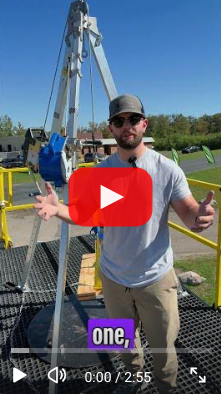
Vertical non-entry rescue. On top of the trailer is where most of the hands-on work happens. Our vertical setup is a tripod outfitted with a rescue SRL, a winch on the back side, and a bosun's chair. Crews learn to set up the tripod themselves, not just look at one that's already standing.
Non-Entry Rescue Training for Every Person, Every Position
Here's the part a classroom can't replicate: your entire crew goes through a full simulated live rescue.
Every person takes a turn in the bosun's chair. They're lowered to the bottom level of the trailer and brought back up. Then they rotate. They work the SRL and perform the retrieval. Then they move to the winch and run that. By the end of the session, everyone has been the person being rescued and the person doing the rescuing.
That rotation matters. In a real emergency, you don't get to pick your role. The person who usually runs the winch might be the one in the space. If only one guy on the crew knows how the equipment works, you don't have a rescue plan. You have a single point of failure.
And being on the other end of the line teaches something no lecture can. Once you've been suspended in a bosun's chair, you understand exactly why smooth, controlled operation of the winch matters.
Why Hands-On Rescue Training Builds Muscle Memory
Our goal is simple. We want to cut out the fluff and give your people something they can actually pull on in an emergency: muscle memory.
Under stress, people don't rise to the occasion. They fall back on what they've practiced. If the only thing a worker has practiced is clicking through an online module, that's what they've got. If they've set up a tripod, run a winch, and pulled a coworker out of a simulated space, that's what kicks in.
We hope your crew never has to perform a confined space rescue. But if they do, we want it to be the second time they've done it, not the first.
It also makes sense from a compliance standpoint. OSHA's permit-required confined space standard (29 CFR 1910.146) expects rescue teams to practice simulated rescues at least once every 12 months. Hands-on training on realistic equipment is the most direct way to show that practice actually happened.
Is Your Confined Space Rescue Plan Ready?
Ask yourself these questions about your current confined space program:
- Could every attendant on your crew set up a tripod right now, without help?
- Has anyone on your team actually operated your winch with a person on the line?
- If your most experienced rescuer is the one in the space, who pulls them out?
- Was your last rescue training something your crew did, or something they watched?
If any of those answers made you pause, that's worth a conversation.
Hands-On Confined Space Training in Michigan
SSI's hands-on confined space training comes to you, with the trailer, the equipment, and instructors who've done this work. Your crew leaves knowing how to wear and inspect a harness, set up a confined space tripod, run an SRL and winch, and perform a non-entry rescue from every position.
Just enough classroom time to cover the fundamentals. No button mashing. Then reps that count.
Want to see if it's a fit for your site? Let's talk about what your crew needs. Call us at 800.632.2955 or email customercare@safetyservicesinc.com.
Train like life depends on it. Train with Safety Services.
------------------------------------------------------------------------------------------------------------------------
Join our Save-ty Club for exclusive deals and safety news. Sign up here.
Share this article on social media and tag us for a special discount on your next purchase.
Let's spread the word on staying safe!
Disclaimer: The content provided on this website is for informational purposes only and is not intended to be a substitute for professional medical advice, diagnosis, or treatment. Always seek the advice of your physician or other qualified health provider with any questions you may have regarding a medical condition.
The information on this site should not be construed as establishing any safety standard or as providing directives for compliance with the Occupational Safety and Health Administration (OSHA) or any other health and safety regulatory agencies. Reliance on any information provided by this website is solely at your own risk. We do not accept any responsibility for any loss which may arise from reliance on information contained on this site.
Safety Services, Inc. | Kalamazoo & Grand Rapids, MI 800.632.2955 | customercare@safetyservicesinc.com Safety Simplified.