
Tired Eyes Miss Things
It's hour six of a shift. Your back aches, your legs are heavy, and the next lift looks a lot like the last forty. That's exactly when an unprotected edge or a missing guardrail is easiest to walk right past.
Exoskeletons aren't new. Passive back, shoulder, and knee supports have been on jobsites for years, and the pitch has always been the same: less strain, less fatigue, fewer sore workers at the end of the day. Ergonomics, and all the good stuff that comes with it.
A study published this month suggests the payoff may go further. When workers are less tired, they may also be better at spotting what could hurt them.
What the Study Found
Researchers at Texas A&M University followed 16 construction workers on a Louisiana jobsite. Each worker completed two three-hour sessions doing their normal work: one wearing a passive lower-back exoskeleton, one without.
Before and after each session, the workers were shown images of construction hazards and asked to identify them and assess the risk.
With the exoskeleton on, workers showed:
- 37% less fatigue
- 29% better hazard recognition
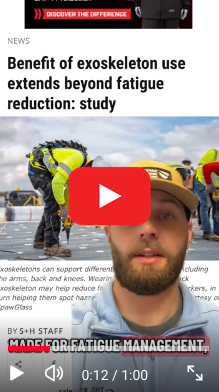
The study was published in the ASCE Open: Multidisciplinary Journal of Civil Engineering and covered by Safety+Health magazine on October 20, 2026.
Body and Mind Work the Same Shift
Lead author Prosper Gbiengu, a doctoral student in Texas A&M's Department of Construction Science, summed it up plainly: "Construction safety involves both your body and your mind." Reduce the physical fatigue, and workers stay more attentive.
That tracks with what anyone who's worked a long shift already knows. Fatigue doesn't just make muscles sore. It narrows attention. You stop scanning and start running on autopilot. The hazards don't change between hour one and hour seven. Your ability to see them does.
Most safety programs treat ergonomics and hazard recognition as separate buckets. One lives with injury prevention; the other lives in training and pre-task planning. This study is a reminder that they overlap. Physical strain is a hazard-recognition problem, too.
The Question Nobody Has Answered Yet
Here's where it gets interesting. The study sessions were three hours long. Real shifts aren't. So what happens at hour six? Hour eight? Hour ten?
It's tempting to assume the gap grows over a full shift. If fatigue keeps stacking up without support, maybe the difference in hazard recognition gets even bigger. Maybe it reaches 40% or 50%.
Maybe. But nobody has measured that yet, and it's worth being straight about what this study can and can't tell us:
- It was small. Sixteen workers is a starting point, not a verdict.
- It was short. Three-hour sessions don't capture end-of-shift fatigue.
- It used pictures. Workers spotted hazards in images, not on a live site with noise, schedule pressure, and production targets.
- It tested one device type. A passive lower-back exoskeleton. Shoulder or knee supports could perform differently.
None of that makes the findings wrong. It makes them promising and worth watching, not a reason to buy a fleet of exoskeletons tomorrow.
Ask Yourself
Before exoskeletons land on anyone's wish list, start with the work itself:
- Which tasks involve repeated bending, lifting, or holding a static posture for long stretches?
- When in the shift do your near misses and incidents tend to happen?
- Are your crews' complaints about soreness and fatigue showing up in your injury data?
- Have you already done what you can with engineering controls, task rotation, and lift aids?
That last one matters most. Exoskeletons are a support tool, not a substitute for designing the strain out of the job. If a task can be redesigned, redesign it first.
Viable Option or Fan Fiction?
Our take: somewhere in the middle, leaning viable. Fatigue reduction was always the main selling point for exoskeletons. This study adds a reason that matters to every safety manager: a less tired worker may also be a more alert one.
The smart move isn't a big rollout. It's a small, measured trial on the tasks where fatigue hits hardest, backed by honest feedback from your crew and your own before-and-after numbers.
We want to hear from the field. Have you tried exoskeletons on your site? Did your crews keep wearing them, or did they end up behind the seat of the truck? Tell us what you're seeing.
And if fatigue and hazard recognition are where you feel the most friction, let's talk about what's not working. SSI can source exoskeletons for a small trial on your highest-strain tasks, so your crew can test them before you commit to more. Small starts. Big wins.
------------------------------------------------------------------------------------------------------------------------
Join our Save-ty Club for exclusive deals and safety news. Sign up here.
Share this article on social media and tag us for a special discount on your next purchase.
Let's spread the word on staying safe!
Disclaimer: The content provided on this website is for informational purposes only and is not intended to be a substitute for professional medical advice, diagnosis, or treatment. Always seek the advice of your physician or other qualified health provider with any questions you may have regarding a medical condition.
The information on this site should not be construed as establishing any safety standard or as providing directives for compliance with the Occupational Safety and Health Administration (OSHA) or any other health and safety regulatory agencies. Reliance on any information provided by this website is solely at your own risk. We do not accept any responsibility for any loss which may arise from reliance on information contained on this site.
Safety Services, Inc. | Kalamazoo & Grand Rapids, MI 800.632.2955 | customercare@safetyservicesinc.com Safety Simplified.