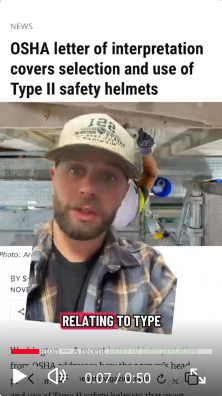
Do You Need Type II Hard Hats? What OSHA's New Letter of Interpretation Says
You don't pick your PPE. Your hazards do.
That's the short version of OSHA's newest letter of interpretation on Type II safety helmets. If you've been going back and forth on whether to switch your crews from Type I hard hats to Type II, this one is worth five minutes.
The letter, dated August 17, 2026, comes from Erin Gilmore, acting director of OSHA's Directorate of Enforcement Programs. It answers six questions about how the general industry head protection standard, 29 CFR 1910.135, applies when workers face side impact hazards. We hit the highlights in our latest video. Here's the full breakdown: what OSHA said, what it didn't say, and what it means for your PPE hazard assessment.
Does OSHA Require Type II Hard Hats?
No. OSHA does not require employers to use a specific ANSI helmet type.
Under 1910.135(b), protective helmets must comply with ANSI Z89.1-2009, Z89.1-2003 or Z89.1-1997, or be at least as effective as a helmet built to one of those standards. That's it. The standard never says "Type II."
But the letter doesn't stop there, and neither should you. ANSI Z89.1 splits helmets into two types based on the impact protection they're designed for:
|
Helmet type |
Designed to reduce impact force from |
|---|---|
|
Type I |
A blow to the top of the head |
|
Type II |
A blow to the top, back or side of the head |
That difference is the whole story. A Type I hard hat is built for things falling from above. It isn't built for a swinging load, a beam you walk into, or a slip that sends your head sideways into a rail.
So while 1910.135 doesn't name a helmet type, OSHA's PPE rules still require you to match protection to the hazard. Which brings us to the question everyone actually cares about.
Can OSHA Cite You for Issuing Only Type I Hard Hats?
Yes, if your workers face side impact hazards.
The second question in the letter was blunt: if OSHA finds lateral impact hazards during an inspection and the employer only issued Type I helmets, will OSHA cite?
OSHA's answer: it may. Inspectors will generally look at whether you assessed your workplace for hazards requiring PPE under 1910.132(d)(1). If they find side impact hazards and your people only have Type I protection, OSHA may cite you under 1910.132(d)(1)(i) for failing to provide PPE appropriate to the hazards.
Notice where that citation lands. It's not the head protection standard. It's the PPE hazard assessment rule. In Question 1, OSHA put it even more directly: where your assessment identifies blows to the top or side of the head, top-only protection may not be adequate, and OSHA will require PPE that addresses those specific hazards. It gave Type II as an example.
Common lateral impact hazards called out in the questions to OSHA include:
- Swinging equipment and suspended loads
- Vehicle and forklift traffic
- Slips, trips and falls that lead to side impacts
- Tight clearances around heavy components or rotating equipment
Three More Answers Worth Knowing
OSHA's 2024 helmet bulletin is guidance, not law. In March 2024, OSHA published a Safety and Health Information Bulletin, Head Protection: Safety Helmets in the Workplace. The letter confirms the bulletin is advisory and creates no new legal requirements. Enforcement is based on the facts at your site and the applicable standards.
High-risk work doesn't automatically mean Type II. The letter was asked about crane operations, rigging, signal work, industrial fabrication and welding. OSHA said these jobs may present foreseeable lateral impact hazards, but the call depends on actual employee exposure. Type II helmets are often an appropriate choice, not the only one. Any head protection that provides equal or greater protection is acceptable.
No General Duty Clause citations here. Because PPE and head protection standards already cover this hazard, OSHA said it would cite those standards rather than the General Duty Clause.
What to Document in Your Head Protection Hazard Assessment
Your hazard assessment is where this gets won or lost. OSHA's PPE assessment rules are performance based, so there's no required form beyond the written certification in 1910.132(d)(2). But the letter spells out what good documentation should show:
- The work areas, tasks or operations you evaluated
- The hazards you considered, including any foreseeable lateral or off-center impact hazards
- Why you chose the head protection you did
- Product performance information, manufacturer instructions or equipment limitations you relied on
OSHA may also look at whether you considered other controls and whether workers were trained on the proper use, care and limitations of their helmets. For a starting framework, OSHA points to the non-mandatory guidelines in 1910 Subpart I, Appendix B.
Ask yourself:
- When did we last walk the floor and update our hazard assessment?
- Does it mention side impacts at all, or only falling objects?
- If we chose Type I in an area with swinging loads or tight clearances, can we explain why on paper?
- Do our people know what their helmet does and doesn't protect against?
If any of those answers made you wince, that's the place to start.
A Note for Michigan Employers
Michigan runs its own state plan through MIOSHA. OSHA states that its letters of interpretation, and the standards they address, may not apply to State Plans. The logic of this letter (assess the hazard, match the PPE, document your reasoning) is sound anywhere, but confirm MIOSHA's head protection and PPE requirements for your site.
The Bottom Line on Type I vs. Type II Hard Hats
OSHA isn't mandating Type II safety helmets. It's holding you to your own hazard assessment. If that assessment finds side impact hazards, top-only protection probably won't cut it, and "we've always used Type I" won't hold up during an inspection.
Not sure where your program stands? We can help you walk through a head protection hazard assessment, sort out which areas need side impact protection, and get the right helmets on the right heads. Where do you feel the most friction? Let's start there.
Call us at 800.632.2955 or email customercare@safetyservicesinc.com.
------------------------------------------------------------------------------------------------------------------------
Join our Save-ty Club for exclusive deals and safety news. Sign up here.
Share this article on social media and tag us for a special discount on your next purchase.
Let's spread the word on staying safe!
Disclaimer: The content provided on this website is for informational purposes only and is not intended to be a substitute for professional medical advice, diagnosis, or treatment. Always seek the advice of your physician or other qualified health provider with any questions you may have regarding a medical condition.
The information on this site should not be construed as establishing any safety standard or as providing directives for compliance with the Occupational Safety and Health Administration (OSHA) or any other health and safety regulatory agencies. Reliance on any information provided by this website is solely at your own risk. We do not accept any responsibility for any loss which may arise from reliance on information contained on this site.
Safety Services, Inc. | Kalamazoo & Grand Rapids, MI 800.632.2955 | customercare@safetyservicesinc.com Safety Simplified.